Home Organization Participants Researchers Use Grants Documentation
Menu
  • Home
  • Organization
  • Participants
  • Researchers
  • Use Grants
  • Documentation
VERA logo
Virtual Experience Research Accelerator

VR-Based Behavioral Research, Transformed

VERA is the Virtual Experience Research Accelerator — a platform that distributes immersive VR experiences to demographically selected, paid participants at home, enabling researchers to rapidly collect behavioral data and responses from a handful of participants for quick tests to hundreds or thousands for highly powered experiments.

Researcher Portal Participant Portal
National Science Foundation

This material is based upon work supported by the National Science Foundation under Award numbers 2235066, 2235068, 2235070, 2350377, and 2235067. Any opinions, findings, and conclusions or recommendations expressed in this material are those of the author(s) and do not necessarily reflect the views of the National Science Foundation.

What is VERA

Human-subjects experiments run in VR

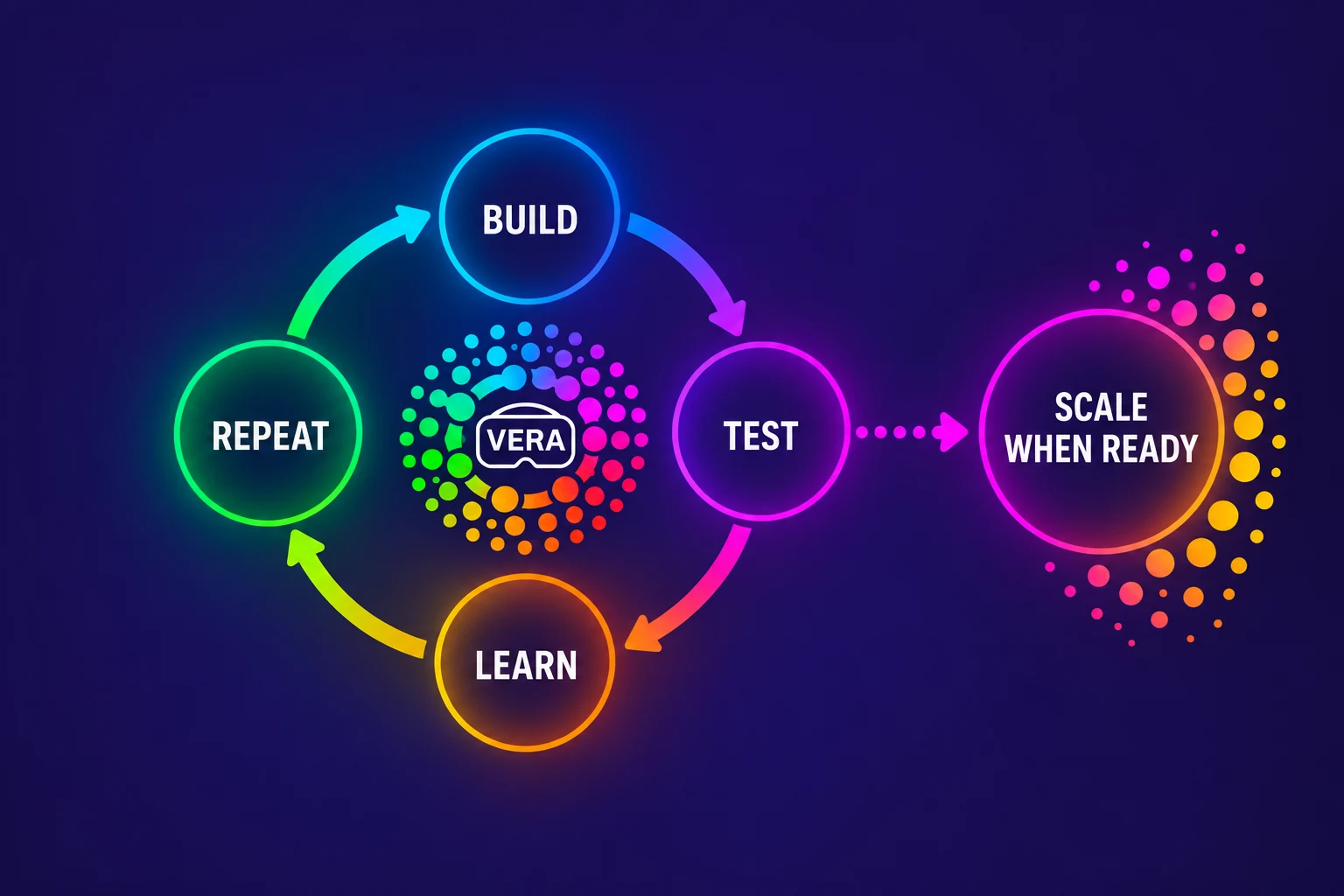
The Virtual Experience Research Accelerator makes immersive human-subjects research fast and iterative. Build a VR experience, deploy it to selected participants at home, collect behavioral data and responses, learn, revise, and run it again. Test an idea with a handful of participants today, refine it tomorrow, and scale to hundreds or thousands when you’re ready — without the time and logistical barriers of traditional lab-based recruitment. VERA Participants receive invitations and can browse available experiments from Researchers, and complete the experiments on their own time at home.

A handful
For quick tests
Hours or Days
Not months
1000+
When scale matters
The VERA research cycle: build, test, learn, repeat — then scale when ready.

Protocol Design

Build immersive VR studies with configurable tasks, scheduling, and recruitment criteria — no lab required.

Immersive Execution

Participants join from home on their own headsets. Sessions run remotely, on their schedule.

Real-time Analytics

Synchronized streams of motion, voice, and task data flow into a centralized repository.

How It Works

Launch VR studies. Reach real participants. Get results.

VERA runs concurrent virtual reality studies with automated workflows, so researchers spend their time on insight, not logistics.

✕ Without VERA

✓ With VERA

Sample Sizes

✕ Without VERA 30–50 participants

✓ With VERA Hundreds or thousands

Demographics

✕ Without VERA Whoever shows up

✓ With VERA The participants you want

Time & Cost

✕ Without VERA Months of paid researchers

✓ With VERA Days of monitoring

Data

✕ Without VERA Scattered all over

✓ With VERA A centralized repository

Synchronized Data Capture

The behavioral data you need, when you need it.

VERA captures synchronized streams of behavior — motion, voice, task performance, and self-report — producing the rich, longitudinal datasets that XR research depends on.

Data VERA Collects
Head & Hand Motion Longitudinal datasets Voice & Audio Task Performance Interaction Events Self-Report Measures
Current Research on VERA

How is VERA being used?

From cybersickness to space tourism, researchers are using VERA to run immersive studies at a scale no single lab could reach.

Cybersickness & Comfort

Validating remote VR research against results from the lab — hundreds of participants with their own headsets.

Perception & Displays

Testing how power-saving rendering changes what people actually see.

Navigation & Spatial Cognition

How environment and immersion shape the routes people choose.

Social Interaction

Personal space, cross-race encounters, and long-term relationships with virtual agents.

Health & Clinical Science

Everyday VR environments as digital biomarkers for chronic migraines.

Learning & Behavior Change

How people attend to, navigate, and learn from immersive information spaces.

Topics under study
Completed
Cybersickness Completed 263 participants

Remote Cybersickness Research at Scale

Cybersickness remains a major barrier to VR adoption, yet most of what we know comes from small, homogeneous lab samples. This study used VERA to deploy a standardized cybersickness testbed remotely, collecting data from 263 participants on their own headsets and comparing the results against a previously published in-lab dataset. Outcomes matched the lab findings, confirming known effects of sex, susceptibility, and expectation at scale and adding well-powered evidence on the debated relationship between age and cybersickness. This study validates VERA as a means of remotely replicating laboratory research.

Read the paper See the studies →
In development
Display Power Savings Pending ~200 participants

Power-Saving Displays and Perceived Visual Quality

VR headsets can extend battery life through display techniques such as uniform dimming, luminance clipping, white-point shifts, and dichoptic dimming, but each carries a cost in perceived image quality. This study tests whether combining these techniques degrades quality additively, less than additively, or more than additively, and whether participant age and sex change how noticeable the loss is.

See the studies →
In development
Spatial Navigation Pending ~200 participants

Navigation Strategies Across Environments

Whether people follow learned routes or take novel shortcuts may depend on the setting they are in and how immersed they feel. This study compares a naturalistic outdoor environment with a constructed maze, and a Meta Quest 3 headset with desktop VR, to see how each shapes shortcut use across a geographically diverse participant pool.

See the studies →
In development
Space Tourism Pending ~400 participants

Passenger Experience in Commercial Spaceflight

As civilian space tourism approaches reality, little is known about what makes passengers feel safe and comfortable aboard a spacecraft. In a 2 × 2 remote VR experiment, this study varies cabin ambiance (calming vs. technical) and virtual crew communication style (supportive vs. procedural), measuring perceived safety, psychological comfort, anxiety, satisfaction, and intention to pursue future spaceflight.

See the studies →
In development
Migraine Biomarkers Pending

VR Digital Biomarkers for Chronic Migraine

Clinicians currently lack objective tools to predict which migraine patients will benefit from a given preventive treatment. Participants with chronic migraine and healthy controls will move through immersive environments that systematically vary brightness, motion, noise, visual complexity, and crowding — a grocery store, airport, office, or park — and report headache intensity, sensory discomfort, and overall tolerability after each. Responses collected before treatment will be compared with later clinical outcomes to test whether behavior in VR can identify migraine phenotypes and predict treatment response.

See the studies →
In development
Social Distance Pending

Race, Gender, and Social Distance in Virtual Encounters

Race and ethnicity shape everyday social interaction, but cross-race encounters are difficult to study consistently in the real world. This study uses standardized virtual encounters to replicate earlier findings on the physical distance people keep from same- and different-race avatars, then extends them to additional racial and ethnic groups, avatars of different genders, and new outcomes including helping behavior. VERA’s reach supports a larger and more demographically diverse sample than prior work in this area.

See the studies →
In development
Virtual Agents Pending

Longitudinal Interactions with Embodied Conversational Agents

This study explores how people interact with embodied conversational agents in immersive virtual reality environments over an extended period of time. Participants engage in social interactions with virtual agents across multiple sessions, and we examine how conversational behaviors and perceptions of the agents change as these interactions unfold. The goal is to better understand the factors that shape persistent human-agent interactions and relationships in virtual reality.

See the studies →
In development
Information Behavior Pending

Immersive Information Behavior Testbed

How do people attend to, navigate, and learn from information in XR? This project builds a reusable Unity-based “Discovery Hall” in which the same content — initially centered on the UN Sustainable Development Goals — is presented as text panels, interactive visualizations, narrative video, and manipulable simulations. VERA’s analytics capture gaze, attention duration, navigation paths, and object interactions, and the study compares headset VR with browser-based participation to understand differences in engagement, learning, and accessibility, with applications for libraries, museums, and education.

See the studies →

8

Studies

2,000+

Participants enrolled or planned

See the studies → Apply for a Use Grant →
Choose Your Portal

Two paths, one platform

VERA connects researchers and participants through dedicated apps. Pick the path that fits you.

Participant Portal

Simple onboarding,
any device

Sign up once, browse paid VR studies, and take part from home on your own headset — compensation shown upfront.

  • Free to join — no research experience needed
  • Browse open studies and join the ones you like, on your own schedule
  • Sessions fit around work or class, fully remote
  • Compensation listed upfront on every single study
Become a Participant →
Researcher Portal

Scalable environments,
granular data

Design VR studies, recruit the participants you want, and capture synchronized behavioral data — all from a single platform.

  • Run studies with hundreds of participants concurrently
  • Drastically lower time and cost per study
  • Enables longitudinal studies across weeks or months
  • Quantitative and qualitative data in one repository
Enter Researcher Portal →
NSF VERA

VERA

Virtual Experience Research Accelerator

vera-xr.io info@vera-xr.org 19 NOV 2026

VERA is supported by the U.S. National Science Foundation and based at the University of Central Florida.

This material is based upon work supported by the National Science Foundation under Award numbers 2235066, 2235068, 2235070, 2350377, and 2235067. Any opinions, findings, and conclusions or recommendations expressed in this material are those of the author(s) and do not necessarily reflect the views of the National Science Foundation.

© Copyright 2024-2026 University of Central Florida for VERA. All rights reserved. | Privacy Policy | Terms of Service | Terminology Guide | Cite